
October 19, 2026
Gemini
Key Takeaways
Transactional printing covers the invoices, statements, and notices your business mails out. Most of the risk sits in the handoffs around the print run, not the printing itself.
- Personalized, deadline-driven documents carry account data marketing mail never touches.
- Manual stuffing and loose file transfers cause most errors.
- Variable data printing and pressure-seal mailers remove manual matching.
- Vet vendors for certifications, encrypted transfers, and mailing records.
Every invoice, account statement, and payroll check your business mails out carries something a marketing flyer never does: data someone may use against you or your customer. A misdirected bill exposes an account number. A stack of statements sitting in an unlocked mail tray can expose a name, address, and balance all at once.
That distinction matters more today than it did a few years back. A financial services data breach now costs $6.3 million on average, the second-highest of any industry IBM tracks, and state-level compliance rules keep expanding faster than federal ones get simplified. Paper mail rarely gets the same security scrutiny as email or cloud storage, which makes it an easy blind spot for finance, HR, and operations teams handling B2B billing, notices, and payroll at scale.
The good news: most of what puts transactional mail at risk comes down to a handful of fixable process gaps.
This article breaks down what transactional printing covers, where costly mix-ups tend to happen in the fulfillment process, and the transactional printing services and practices that keep sensitive documents accurate, compliant, and out of the wrong hands.
What is transactional printing?
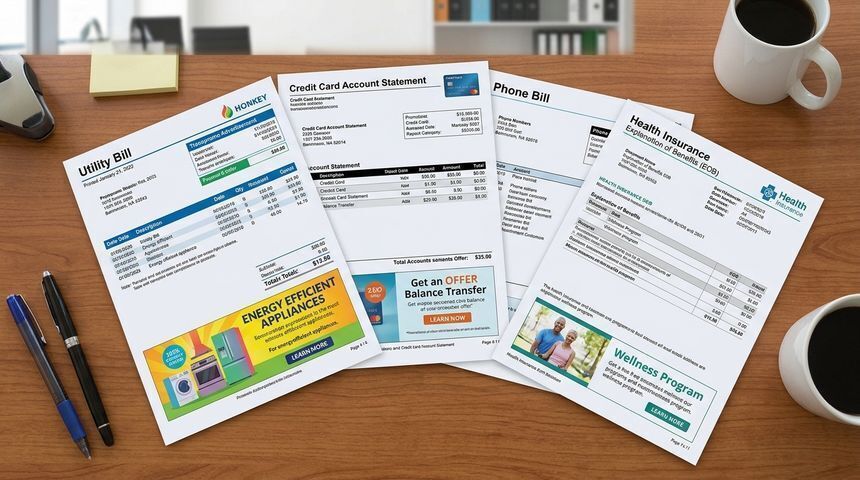
Transactional printing, sometimes called transaction printing, is the production and mailing of documents triggered by a specific business transaction or ongoing account relationship, such as invoices, bills, account statements, and compliance notices. Unlike marketing print, which sends the same message to a broad list, transactional documents are personalized per recipient, time-sensitive, and often legally required to go out on a set schedule.
That distinction changes how the entire print and mail process needs to work. Delays and mismatches that a promotional run can absorb turn into compliance problems here. A few things set transactional printing services apart from standard commercial print runs:
- Data accuracy is non-negotiable. Each document pulls from a live data feed (account numbers, balances, transaction history), so a single formatting error can misroute sensitive information to the wrong person.
- Timing is often regulatory, not promotional. Billing statements, and compliance notices usually carry legal deadlines attached, not just a marketing calendar.
- The content itself is sensitive. Most transactional mail contains personally identifiable information (PII) or financial data, making security features and compliant handling matter more in this type of print job.
What counts as BTB Mailing?
B2B mailing refers to transactional documents exchanged specifically between businesses. Invoices between a vendor and a client, contract renewals, compliance notices sent to partner organizations, and recurring account statements between a service provider and a business customer all fall under this umbrella.
The stakes—exposed data, compliance risk—look similar to consumer transactional mail, but the audience and cadence often differ: B2B mail tends to follow billing cycles, contract terms, or regulatory reporting periods rather than individual customer triggers.
Where transactional mailing breaks down
Most costly mistakes in transactional mail happen around the printing process, not because of it: the handoffs, the manual steps, the moments where a human has to match one document to one envelope, thousands of times in a row, without making a mistake.
A few points in the process account for most of the costly errors:
- Manual envelope stuffing. When statements are folded and inserted by hand or on older equipment without a match-and-verify step, a misfeed can put the wrong document in the wrong envelope. Multiply that by a few thousand pieces, and even a small error rate adds up to a meaningful number of misdirected accounts.
- Unencrypted or loosely handled file transfers. Billing data often moves between systems, an ERP, a billing platform, a print vendor, before it ever reaches a printer. Each handoff is a chance for that file to sit somewhere unprotected.
- No proof of mailing. If a compliance notice or transactional document goes out without a tracked, verifiable mailing record, there's no way to confirm it was sent on time or to the right address if a dispute comes up later.
- Mixing transactional and marketing mail workflows. When the same team or process handles both bulk marketing mail and sensitive account statements, transactional mail can end up following looser standards than it should, simply because it's processed alongside lower-stakes material.
7 Best Practices for Secure BTB Mailing
None of the points above require a full system overhaul. Most are process and vendor decisions that close the specific gaps above, and several can be implemented without touching the systems already generating your billing or account data.
1. Vet providers for documented security and quality practices
A print and mail vendor claiming to be "secure" isn't the same as one that's proven it. Ask what compliance certifications or standards a provider holds, and get specifics rather than a general assurance. ISO 9001 certification, for instance, verifies that a vendor's quality management systems are formally documented and consistently followed.
The standard was just updated, too: ISO 9001:2026 published in September, sharpening its focus on quality culture and accountability at the organizational level, not just paperwork on file.
If the mail involves healthcare-adjacent data, Health Insurance Portability and Accountability Act (HIPAA) compliance needs to be part of that conversation too, along with documented safeguards around how protected health information moves through the print process. The distinction matters because a vendor's internal claims tell you far less than an actual certification or audited standard.
2. Use Variable Data Printing to eliminate manual matchig
Variable Data Printing (VDP) pulls each recipient's information directly from a data file and merges it into their specific document during the print run itself, matching name, account number, and content in one automated pass instead of relying on someone to fold and stuff the correct statement into the correct envelope by hand. This closes the gap responsible for a large share of misdirected mail.
Beyond accuracy, VDP scales in a way manual processes can't. Whether you're mailing 500 statements or 50,000, the matching logic works the same way, so growth doesn't introduce more room for error.
3. Build physical security features into secure document printing
Checks, financial notices, and other high-value documents benefit from security features that make tampering or duplication visible. A few of the most common:
| Feature | What It Does |
|---|---|
| Void pantograph | Reveals a hidden "VOID" watermark when the document is photocopied |
| Microprinting | Text so small it appears as a solid line to the eye, but distorts when copied or scanned |
| UV security ink | Invisible under normal light, visible only under UV, and doesn't reproduce on a scanner |
| Thermochromic ink | Changes or disappears with heat or touch, confirming the document is an original |
These features don't stop every attempt at fraud, but they make tampering obvious fast, which is often enough to deter it in the first place.
4. Move to pressure seal mailers over manual envelope stuffing
Pressure-seal mailers, sometimes called InfoSeal forms, are self-contained documents that fold and seal into their own mailer, no separate envelope required. Since the document and the mailing piece are one continuous sheet, there's no step where a printed statement could get matched to the wrong envelope. The content, the seal, and the address all come from the same pass through the same machine.
Beyond removing that error point, pressure-seal forms cut a production step entirely. There's no envelope inventory to manage, no separate stuffing process, and no risk of an envelope window misaligning with the address printed inside.
5. Secure the data pipeline before it reaches print
Physical document security means little if the file behind it was never protected in the first place. Billing data typically passes through several systems before a single page prints—for instance, Enterprise Resource Planning (ERP) software, a billing platform, or the print vendor's intake. Each of those handoffs should happen over encrypted channels like Secure File Transfer Protocol (SFTP), not standard email attachments or unsecured file-sharing links.
This is also where it's worth asking a potential print partner a direct question: how does the data get from your system to theirs, and what happens to that file once the job is complete?
6. Maintain audit trails and proof of mailing
Every piece of transactional mail should leave a record: when it was printed, when it entered the mail stream, and ideally, tracking that confirms delivery. This matters most when a dispute comes up later, a customer claims they never received a notice, or a regulator asks for proof that a compliance document went out on time. Print fulfillment partners that build this into their standard process save you from scrambling to reconstruct a mailing history after the fact.
Beyond removing that error point, pressure-seal forms cut a production step entirely. There's no envelope inventory to manage, no separate stuffing process, and no risk of an envelope window misaligning with the address printed inside.
7. Keep transactional mail workflows separate from marketing mail
When the same team, equipment, or process handles both bulk marketing postcards and sensitive account statements, transactional mail can end up following the same relaxed standards as lower-stakes material simply because it's moving through the same pipeline. A misdirected coupon costs little. A misdirected billing statement carries far more weight.
Keeping these workflows distinct—separate staging, handling, and quality checks—comes down to matching the process to what's actually at stake in each type of mail.
Print It Once, Print It Right
The quickest wins tend to come from the steps that involve the most hands. Shift your statement runs onto pressure seal forms, let the data file drive the match, and a good share of misdirected mail drops out of the process before you've changed anything else.
After that, the questions for a print partner get narrower and more useful: how does our data reach you, what happens to that file once the job closes, and what record comes back when a recipient disputes delivery?
Intermedia Print Solutions can answer all three. We handle transactional printing services, mailing solutions, business forms, checks and banking supplies printing in-house, so your sensitive documents stay under one set of standards from data intake to mail stream.
Send us the details of your next invoice or statement run — request a quote or place an order and we'll match it to the right printing services for the job.
Transactional Printing and BTB Mailing: FAQs
Frequently Asked Questions
What documents count as transactional printing?
Invoices, account statements, checks, bills,, payroll documents, and compliance notices all fall under transactional printing. Any document a business generates from customer or account data and mails on a set schedule belongs in this category.
How is transactional printing different from direct mail?
Direct mail sends the same promotional message to a broad list. Transactional printing produces a unique document for each recipient, pulled from live account data, and usually carries a legal or contractual deadline rather than a marketing one.
What are pressure seal forms, and why use them?
Pressure seal forms fold and seal into their own mailer, so no separate envelope is needed. Because the document and mailer are one sheet, a statement can't end up in the wrong envelope. They also cut envelope inventory and stuffing costs.
How do I choose a secure transactional printing partner?
Ask for documented certifications rather than general assurances, and find out exactly how your data reaches them and what happens to it afterward.
- Confirm they use encrypted transfers, keep audit trails, and provide proof of mailing for every run.
Does transactional printing need to be HIPAA compliant?
Only when the mail contains protected health information, such as patient billing statements or insurance notices. In those cases, your print vendor needs documented HIPAA safeguards covering how that data moves through their process, not just a verbal assurance.